Louis IX commissions a sacred setting
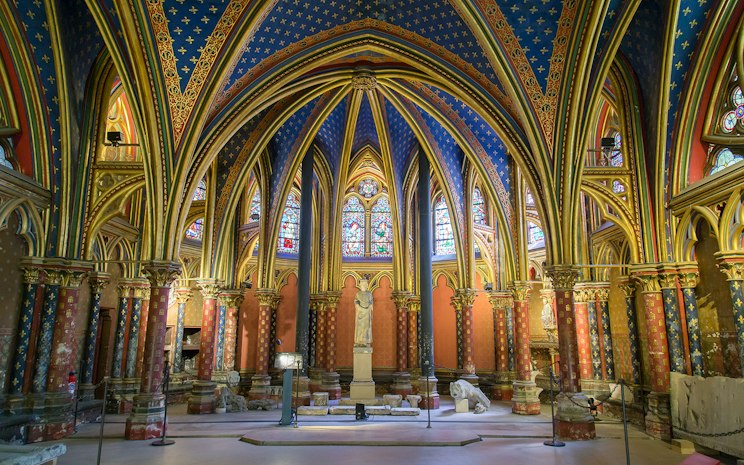
The king built Sainte-Chapelle within his existing palace on Île de la Cité. Its purpose was to house relics associated with Christ’s suffering and death.
Sainte Chapelle history reaches beyond its stained glass. Louis IX built this royal chapel in 1242–1248 for sacred relics; revolution and restoration later transformed it. Learn to separate medieval survival, later additions and repaired decoration when you visit.
Its setting within the Palais de la Cité joined Christian devotion to royal authority.
The king built Sainte-Chapelle within his existing palace on Île de la Cité. Its purpose was to house relics associated with Christ’s suffering and death.
Louis acquired the Crown of Thorns in 1239 and further relics in 1241. The collection included a fragment of the True Cross.
Roughly two-thirds of the stained glass is medieval. The western rose dates from around 1485, while major restoration in 1840–1863 reshaped the damaged interior.
The building survived changes of purpose as well as changes of style.
Louis IX acquired the Crown of Thorns through negotiations with Baldwin II of Constantinople. Further acquisitions created the collection that justified a new chapel.
Louis’s builders placed the royal chapel above a lower chapel serving palace staff. The medieval master builder’s identity remains uncertain.
Under Charles VIII, a Flamboyant Gothic rose replaced the earlier window. Its 87 panels depict the Apocalypse of Saint John.
Revolutionary damage destroyed the shrine and dispersed relics. The chapel ceased being assigned to worship and later served as a flour warehouse.
The judicial administration used the chapel for archives. Meanwhile, the Crown of Thorns entered Notre-Dame’s treasury in 1806.
Duban, Lassus and Boeswillwald led major restoration after damage and archive use. Their work helped establish French historic-monument restoration practice.
Today’s monument preserves the legacy of that restoration, not an untouched medieval room. Its royal religious function belongs to its history.
The relic collection cost approximately 135,000 livres tournois. Its value helps explain why Louis commissioned such an elaborate setting.
Six Apostle statues, including Saint Peter, retain medieval elements. An ancient subject does not make every visible surface original.
The upper chapel contains 15 major stained-glass bays and 1,113 scenes. Together, the glass covers approximately 670 square metres.
You need not memorise every patron. These dates separate the main layers.
The windows connect scripture with the arrival of relics in France.
Rayonnant Gothic gives tall windows a dominant role. Painted vaults and slender stone divisions complete the upper room.
The Bay of the Relics shows Louis IX carrying relics barefoot beside his brother Robert d’Artois.
Louis appears barefoot, honouring the relics. Yet the image also places the French king within their sacred story.
Devotion and royal power are connected here, not competing explanations.
Its later date matters: Charles VIII’s window added to Louis IX’s chapel rather than simply repeating its design.
The room can overwhelm. A short list helps you separate its periods without studying every scene.
The move upstairs once marked social rank: palace staff below, the king and his circle above.
His bare feet express devotion; his presence connects French kingship to the biblical stories surrounding him.
Compare its stone patterns with the tall bays. You are comparing Charles VIII’s period with Louis IX’s.
Remember that six retain medieval elements. Their shared appearance does not mean every statue has the same material history.
Read the painted decoration alongside the glass. The room’s unity conceals centuries of damage and repair.
The relic stories survive in glass, but the original shrine does not. That absence records the Revolutionary break.
Compare the two levels first, then the tall windows and later rose. Keep the missing shrine and restored surfaces in mind. Use our visitor guide to turn that historical context into a visit plan.